Noodles East · Chinese home cooking
Braised Noodles with Long Beans and Pork
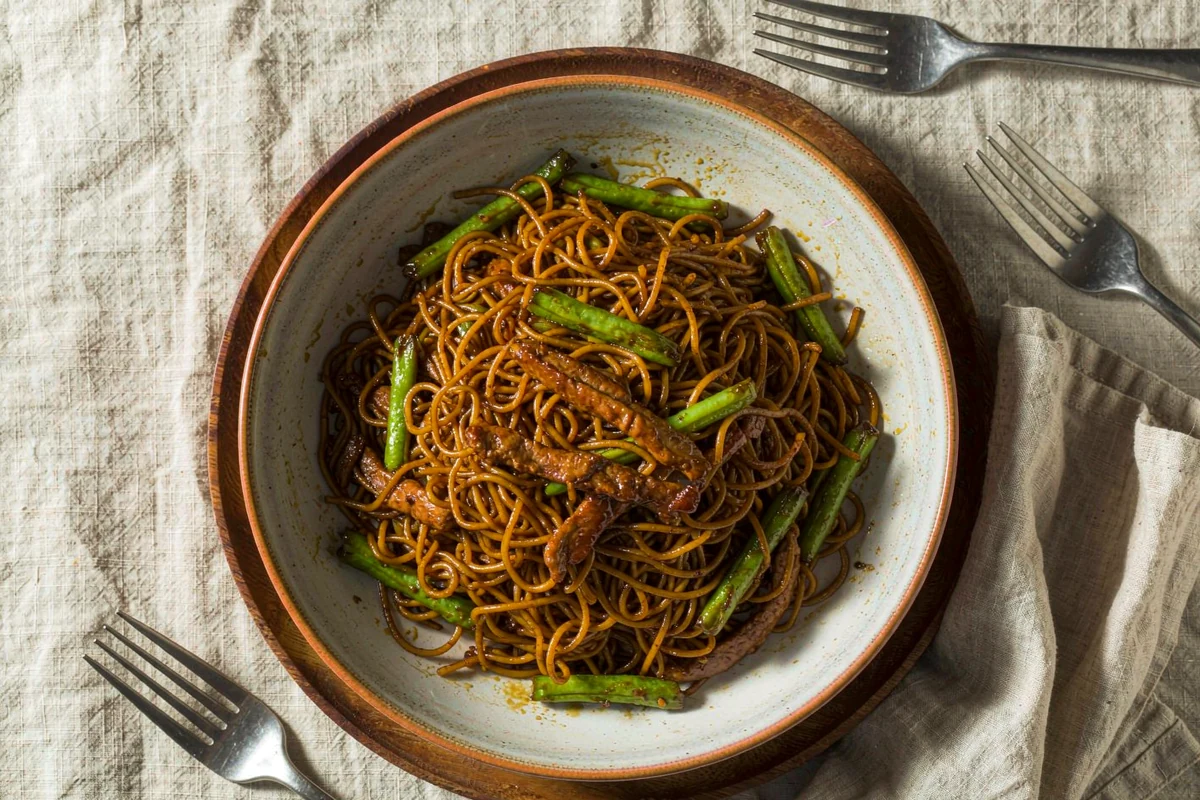
Fresh wheat noodles are layered over a shallow braise of pork and long beans, then steamed in the trapped steam until they drink up the sauce and stay springy rather than soggy.
About this dish
Braised noodles ask for patience with a lid, not a rolling boil. Pork and long beans build a shallow braise in the wok; raw noodles sit on top, not in the liquid, and cook in trapped steam. You hear a low, steady ticking as the strands turn from stiff and pale to plump and tawny. Lift the lid near the end and the sauce has vanished into them. The beans keep a slight squeak, the pork stays soft, and the pan leaves caramelised, lacy edges worth scraping up.
Before you start
Equipment: Wok. Tap the ingredient checkboxes as you go.
Method
7 steps · tick each one off as you finish it.
Oil the noodles
Toss 350 g fresh noodles with 1 tbsp oil and 1/4 tsp salt, off the heat, until every strand is lightly coated and separates. Spread them on a tray for 10 minutes so the surface dries slightly; they should look satiny, never damp or clumped.
Brown the pork
Set a wok over medium-high heat with 2 tbsp oil and sear 250 g pork strips for about 3 minutes, stirring twice. Move on when the edges are browned, the fat has turned translucent and the pan smells richly savoury rather than raw.
Blister the beans
Add 20 g garlic and 250 g long beans, and stir-fry over high heat for 2 minutes. Stop when the beans brighten to a vivid green, show a few blistered spots and give off a fresh, grassy smell; do not let the garlic scorch.
Build the braising liquid
Pour in 3 tbsp light soy sauce, 1 tbsp dark soy sauce, 1 tsp sugar and 400 ml hot stock; bring to a lively simmer over medium-high heat in 2 minutes. It has had enough when the liquid looks deep amber and still covers the beans.
Steam the noodles
Scatter the oiled noodles evenly over the simmering braise, keeping them above the liquid, then cover the wok tightly, lower the heat to medium-low and steam for 12 minutes. Ready when the noodles are plump and tawny and the lid is fogged with condensation.
Toss everything together
Uncover, drizzle 1 tsp sesame oil over the noodles and toss everything together over low heat for about 90 seconds, until the sauce clings evenly, no dry white strands remain and the bottom shows a few lacy, caramelised patches.
Rest and serve
Turn off the heat, fold through 40 g scallions and rest the pan, covered, for 2 minutes. Serve when the scallions have just softened but stay bright green, the beans keep a faint squeak and the noodles spring back when pressed with chopsticks.
Tips that matter
- Keep the noodles above the braise, not submerged; if they sit in the liquid they turn to paste instead of steaming.
- A tight lid matters. If yours is loose, lay a sheet of foil under it so the steam cannot escape during the 12 minutes.
Easy variations
- Replace long beans with 250 g green beans or sliced flat runner beans, cut to the same 4 cm length.
- Use 250 g sliced chicken thigh in place of pork and 400 ml chicken stock, reducing the sear to 2 minutes.
Questions that come up
My noodles stuck together in one clump. What went wrong?
They went in damp or were piled too thickly. Toss with oil, spread them loosely over the braise, and resist stirring until the final toss.
Can I use dried noodles?
Yes, but boil them for 2 minutes less than the packet says, drain, oil them, and cut the braising liquid to 300 ml so they do not go soggy.
Nutrition, roughly
| Energy | 520 kcal |
|---|---|
| Protein | 26 g |
| Carbohydrate | 62 g |
| Fat | 18 g |
Estimated per serving from standard ingredients, rounded. Treat it as a guide, not clinical data.
Boiling Noodles and Pasta Well
Salt, water volume, the two-minute window and the starchy cooking liquid that most home cooks pour down the sink.