Noodles East · Chinese home cooking
Braised Beef Noodle Soup
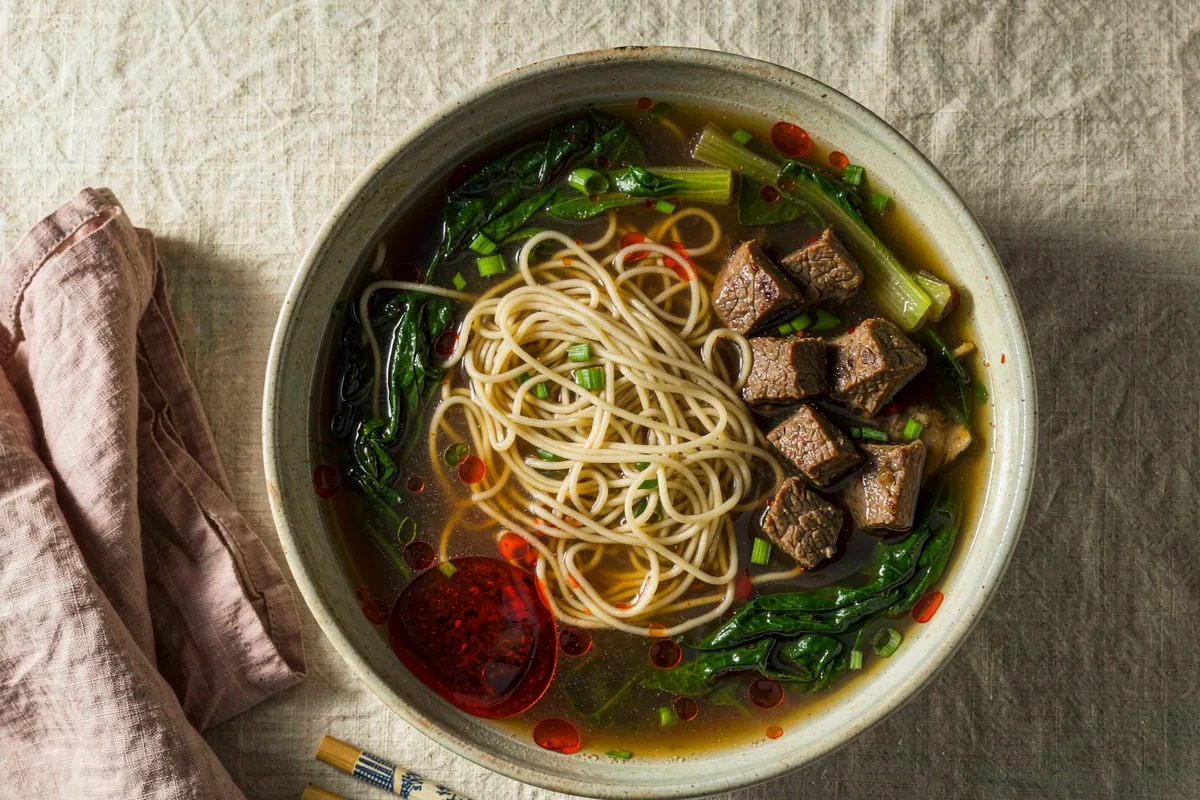
Beef shank braised for two hours with ginger, soy and star anise until the slices hold their shape but yield to a chopstick, served over noodles in the dark broth.
About this dish
Shank, not a tender steak, is the right cut. Its connective tissue melts into gelatine and gives the broth a rounded body a lean cut cannot produce. Brown the cubes hard first; those dark edges are where the deep flavour comes from. Leave the pot alone for two hours at a bare simmer, since a rolling boil tightens the muscle into dry string. Call it done when a chopstick slides into a cube with no resistance and the kitchen smells of anise, ginger and warm soy. Salt at the end.
Before you start
Equipment: Pot. Tap the ingredient checkboxes as you go.
Method
8 steps · tick each one off as you finish it.
Blanch the beef
Put the cubes in a pot, cover with cold water and bring to a boil over high heat for 5 minutes. Grey foam will rise; drain and rinse each cube under warm water. This removes the impurities that would otherwise cloud the finished broth.
Brown hard
Heat 2 tbsp oil in a heavy 3 litre pot over medium-high heat for 2 minutes. Brown the beef in two batches, 3 minutes each, until every side is deep brown and a dark crust forms on the base.
Build the aromatics
Return all the beef, add the onion, ginger and garlic and stir for 2 minutes until the onion edges soften and smell sweet. Pour in the Shaoxing wine and scrape the base once; it should hiss and lift the browned bits into the liquid.
Add liquid and spices
Add 1.6 litres water, both soy sauces, sugar, star anise and peppercorns. Bring to a boil, about 6 minutes, then skim the surface once with a ladle. The liquid should be a clear dark amber, not cloudy, before you lower the heat.
Braise at a bare simmer
Cover, drop to the lowest heat and braise 2 hours without lifting the lid. Small bubbles should break the surface every few seconds; if it rattles hard, the meat will seize. A chopstick must slide into a cube with no resistance at the end.
Season and rest
Fish out the star anise and ginger slices, taste, and add salt only now, 1/2 tsp at a time, until the broth reads round rather than flat. Turn off the heat and rest 15 minutes; the surface should show a thin, glossy film of fat.
Noodles and greens
Boil 2 litres water in a separate pot and cook the noodles 4 minutes for fresh, 7 for dried, until springy with no white core. Blanch the greens in the same water for 60 seconds until deep green, then divide both among four bowls.
Ladle and finish
Reheat the broth to a bare simmer, then ladle it over the noodles and top with 3 or 4 beef cubes per bowl. Add scallions, coriander and a spoon of chilli oil. The broth should look dark and clear, with a fine sheen on top.
Tips that matter
- Salting early tightens the meat over a long braise. Season only after the beef is tender, then taste again the next day and adjust.
- The broth is better made a day ahead. Chill it, lift off the solid fat, then reheat gently; the flavour settles and the texture turns silkier.
Easy variations
- Add 200 g peeled and halved daikon radish for the last 30 minutes of braising for a sweet, translucent vegetable in the broth.
- Swap shank for oxtail and add 30 minutes to the braise; the bones give an even richer, more gelatinous body.
Questions that come up
Why is the beef still tough after two hours?
The heat was too high or the cubes were too lean. Keep a bare simmer and use shank or chuck with visible connective tissue, which needs time rather than temperature.
Can I use a pressure cooker?
Yes. Cook at pressure for 45 minutes, release naturally, then simmer uncovered 10 minutes to reduce the broth slightly before seasoning.
Nutrition, roughly
| Energy | 720 kcal |
|---|---|
| Protein | 48 g |
| Carbohydrate | 70 g |
| Fat | 26 g |
Estimated per serving from standard ingredients, rounded. Treat it as a guide, not clinical data.
Boiling Noodles and Pasta Well
Salt, water volume, the two-minute window and the starchy cooking liquid that most home cooks pour down the sink.