Congee, Porridge & Oats · Chinese home cooking
Eight-Treasure Congee
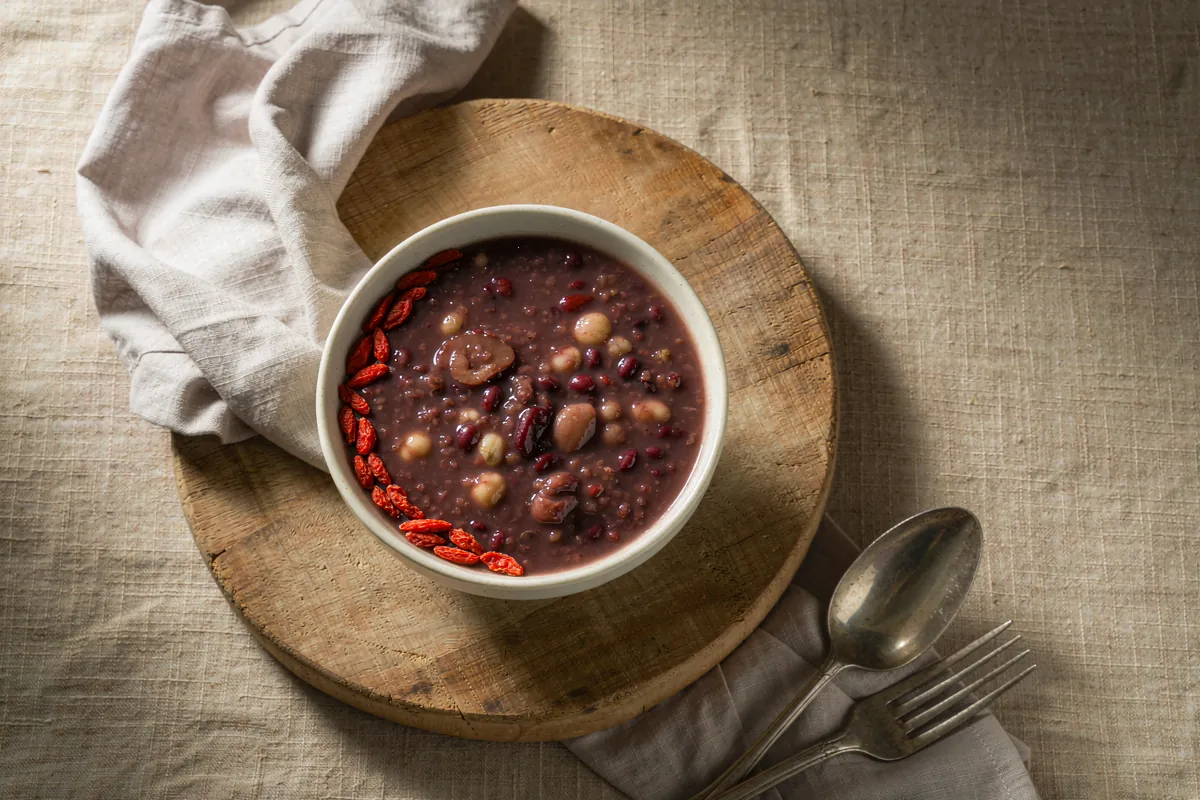
Glutinous rice, red beans, peanuts, dates and dried fruit simmered slowly into a thick, faintly sweet porridge, darkened to a deep russet by the beans.
About this dish
Eight-treasure congee is a pantry-clearing exercise with one fixed rule: the hard things go in first. Red beans, peanuts and barley need a soak and a head start, while glutinous rice, dates and dried fruit would turn to paste if added together. Soaking the beans overnight is the difference between a silky bowl and one with hard little stones in it. The pot smells of dates and warm grain long before it is done. It should finish thick enough to hold a spoon upright, with the beans whole but tender.
Before you start
Equipment: Pot. Tap the ingredient checkboxes as you go.
Method
8 steps · tick each one off as you finish it.
Soak the hard things
Put the red beans in 300 ml cold water and leave overnight, at least 8 hours; they should swell to nearly double and wrinkle at the surface. Soak barley, peanuts and lotus seeds separately for 2 hours. Drain everything and discard the soaking water.
Parboil the beans
Put the drained beans, barley and peanuts in a 3 litre pot with 2 litres water. Bring to a boil, then simmer uncovered on low for 25 minutes, skimming grey foam once. A bean should crush between finger and thumb yet hold its shape.
Add the rices
Rinse both rices for 60 seconds until the water runs clear. Stir them in with the lotus seeds and simmer on low for 25 minutes, stirring every 8 minutes so the glutinous rice does not glue itself to the base.
Add the fruit
Stir in the dates, longan and half the goji berries. Simmer 15 minutes more, uncovered, until the dates look plump and glossy and the liquid has turned a deep russet. The pot should now smell sweet and fruity rather than plainly starchy.
Sweeten carefully
Add the sugar and the salt and stir for 2 minutes until no grains remain at the bottom. Taste and add up to 1 tbsp more sugar if you want it sweeter; the dates and longan already carry a lot of sweetness, so go slowly.
Check the body
Simmer a final 5 minutes on the lowest heat, stirring constantly. The congee should be thick enough that a spoon drawn through leaves a channel that closes over 5 or 6 seconds, with whole beans suspended rather than sunk to the bottom.
Rest
Turn off the heat, cover and rest 10 minutes. The porridge tightens noticeably as it settles and the last dried fruit plumps in the trapped steam. If a skin forms on top, simply stir it back in; it is only starch, not a fault.
Serve
Ladle into small warm bowls; the surface should look glossy and deep russet, with pale lotus seeds and red dates breaking through. Scatter the remaining goji berries and sesame seeds, and add a thin swirl of coconut milk if you like.
Tips that matter
- An overnight soak is not optional for the red beans; a quick soak leaves hard centres that no amount of simmering will fully soften.
- Use a heavy-based pot and keep the heat low once the rice goes in. Glutinous rice scorches fast and a single burnt patch taints the whole batch.
Easy variations
- Replace the barley with 40 g black glutinous rice for a darker, purple-tinged congee and a slightly chewier bite.
- Skip the sugar entirely and serve with a spoonful of honey at the table, or add 60 g diced fresh pumpkin with the rices.
Questions that come up
Why are the beans still hard after an hour?
Old beans or hard water are usually to blame. Soak them a full 12 hours with 1/4 tsp bicarbonate of soda in the water, then rinse well before cooking.
Can I use a pressure cooker?
Yes. Cook the beans, barley and peanuts for 12 minutes at pressure, release naturally, then add the rices and fruit and simmer uncovered for 20 minutes.
Nutrition, roughly
| Energy | 330 kcal |
|---|---|
| Protein | 9 g |
| Carbohydrate | 66 g |
| Fat | 5 g |
Estimated per serving from standard ingredients, rounded. Treat it as a guide, not clinical data.
A Staple Cupboard That Earns Its Space
A short list of grains, flours and dried noodles, how long they actually keep, and what each one can become once it reaches the pan.